
Need to get started
Your gut says your biggest risk is doing nothing with AI, but you're unsure how to get started.
Translate complex AI into clear results with visual storytelling. A leadership playbook — not a tech manual — for executives who need AI to move from buzzword to business value.
Northeastern State University teaches Show AI—Don't Tell It in its “special topics in cybersecurity” curriculum and its new AI degree program.
Adopted as course material for the next generation of AI and security leaders.
If any of these is you — this book is for you
Your gut says your biggest risk is doing nothing with AI, but you're unsure how to get started.
Your successful AI pilot is gathering dust while your business and tech teams disagree on the path forward.
You're making progress with AI but need to build momentum and turn it into a self-driving innovation engine.
Your teams see AI as a threat to their jobs instead of a tool to amplify their expertise.
There is no desire greater than to alter someone else's draft.
AI isn't failing because it's too technical. It's failing because we're not showing what success looks like.
A beloved teacher taught me that people engage far more with a draft than a finished pitch. That single idea became the foundation of my philosophy.
Early in my career it led me to share rough drafts first — turning passive presentations into active co-creation sessions where others shape the outcome with me.
In one boardroom we skipped slides and brought a holographic AI agent wearing the client's team jersey, interacting with simulated fans on game day, right in front of them.
Funding was unlocked. Belief was born. That's the power of showing, not telling.
Inside the book
A leadership strategy playbook for executives, change agents, and boardroom decision-makers — the proven system for turning potential into performance.
Build unstoppable momentum with the AI Performance Flywheel™ — Foundation, Execution, Scale, and Innovation.
A four-phase momentum system
Ground strategy in research-backed pillars, from Business Value Creation to Data as Strategic Asset.
A research-backed strategy map
Master Visual Dartboarding™ and pick the right visual for the right audience — ROI heatmaps for the CFO, workflow diagrams for the team.
The right visual for every audience
Early praise
6 endorsements · CIOs, analysts & operators
Her step-by-step methodology is the essential AI guide for driving collaborative, secure innovation, fast.
“Critical resource for business leaders — this book fills in all the gaps between LLMs and making money!”
“Every services partner chasing AI deals needs a blueprint like this for turning strategy into action and pipeline into revenue.”
“If you want to turn skeptics into champions, show them exactly how AI changes the game for your business.”
“Finally, a playbook that shows how to unlock AI's power with business leaders, not just engineers, and demystifies the path from vision to real value.”
“Dr. Lisa delivers the field guide for leaders ready to secure the future by pairing advanced technology with courageous human leadership.”
CEOs, CIOs, CFOs, COOs, innovation leads, and board directors.
Leaders pitching strategy, aligning stakeholders, or launching pilots.
Teams feeling stuck, stalled, or short on traction.
No code. No engineering degree. Just a visual toolkit and a new way to lead.
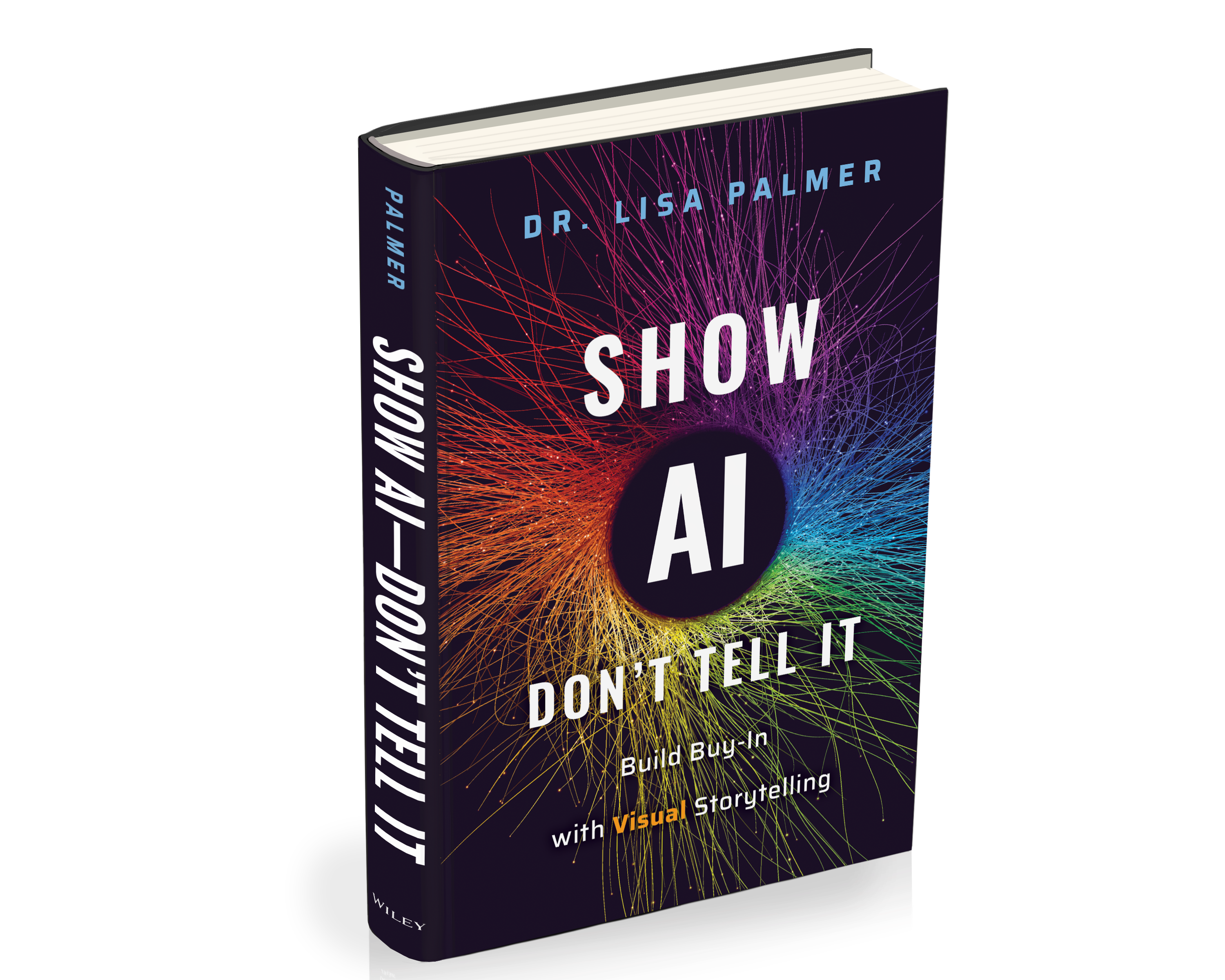
Show AI—Don't Tell It: Build Buy-In with Visual Storytelling, by Dr. Lisa Palmer, published by Wiley.
Senior business leaders expected to lead AI initiatives — CEOs, CFOs, CIOs, COOs, and board members — who need to guide strategy and build buy-in without a PhD in data science.
It equips executives with a pragmatic, proven system for turning AI initiatives into measurable business outcomes. It is a leadership playbook rooted in real-world experience, grounded in the belief that transformation happens only when people feel, see, and trust AI: how to align teams, secure funding, gain traction, and scale impact.
The Bold AI Leadership Model™, built on three components: Mindset (the four Applied AI Guiding Principles), Strategy (the five research-backed AI Success Pillars), and Action (visualization tools for strategic, iterative execution).
It is the key to making AI real inside the enterprise: a leadership approach that uses visualization to translate strategy into business language, demonstrate ROI through early wins, turn resistance into momentum, and align technical and non-technical teams. You demonstrate AI's value visibly rather than explaining technical details.
The foundational layer of the model, built on four guiding principles: Business Value (tangible, measurable results from pragmatic innovation), Speed with Rigor (agility plus structure), Simplicity (making AI approachable and understandable so trust and adoption follow), and Human-Centricity (AI augments people rather than replacing them).
The Five AI Success Pillars are the Strategy layer of the Bold AI Leadership Model, validated in the doctoral research: Business Value Creation, Customer-Centricity, Collaborative Teams, Cultural Shifts, and Data as Strategic Asset. Full definitions live at neurocollective.ai/faqs.
The Mindset introduces the beliefs and behaviors required for strategic AI leadership. The Pillars provide the strategic map — a structured foundation that keeps AI initiatives focused, aligned to business priorities, and able to scale instead of stalling.
The AI Performance Flywheel is the Action layer of the Bold AI Leadership Model: four phases of compounding momentum — Foundation Momentum, Execution Momentum, Scale Momentum, and Innovation Momentum. Full definitions live at neurocollective.ai/faqs.
Visualization is the catalyst for change. Leaders must show, not tell, AI's value to secure buy-in, because visuals turn abstract concepts into tangible experiences that teams can see, relate to, and trust. It breaks down complexity and fuels every momentum phase of the AI Performance Flywheel™.
A technique for accelerating decisions and stakeholder alignment: create a visual draft of a plan, model, or concept and invite stakeholders to react to it and refine it. An imperfect sketch beats a blank page, and reacting to a draft turns abstract discussion into co-ownership.
Through Execution Momentum: leaders dismantle barriers with stakeholder-specific visualization strategies. Executives, IT teams, and frontline staff each need tailored visuals and messaging that speak to their concerns, from ROI skepticism to fear of job displacement.
Board presentation, pilot launch, or full transformation